
The energising spring is the smallest component in any seal assembly. But small does not mean simple and, as the most highly stressed component in the seal, underestimating their importance can have serious consequences.
Selecting the correct energising spring for seals and valve applications has a major impact on sealing performance, service life and reliability.
Find out more about what drives spring performance, and the full picture of what to consider when making your spring selection.
The simplest explanation of what an energising spring does is that it makes your seal seal. This is true enough, but it’s not the full story. And when it comes to making engineering decisions there’s so much more to know if you want to ensure you’re choosing the spring that will give you the maximum performance where you need it.
Each energising spring offers different results, depending upon its type, geometry, material or specification. Whether that’s how much force the seal will apply to the sealing surface, whether that force will be consistent or degrading, and how long the seal will continue to perform effectively under operating conditions.
If any of the elements are wrong for the application or environment, you face the prospect of seal failure. Occasionally this can be catastrophic. Usually it’s gradual. A slow leak that becomes a maintenance event, a replacement cycle that starts sooner than expected, a piece of equipment that never quite performs to its potential. And the challenge with these gradual failures, is that they are often accepted as normal wear, rather than understanding that a different spring could result in a much improved outcome.
We’re not trying to turn engineers into spring specialists, but we hope that clarifying how the spring decision is a genuine engineering decision, and highlighting what to consider when making it, will be genuinely useful for you, your seals, and your business.
Geometry Is Not a Detail — It Is the Design
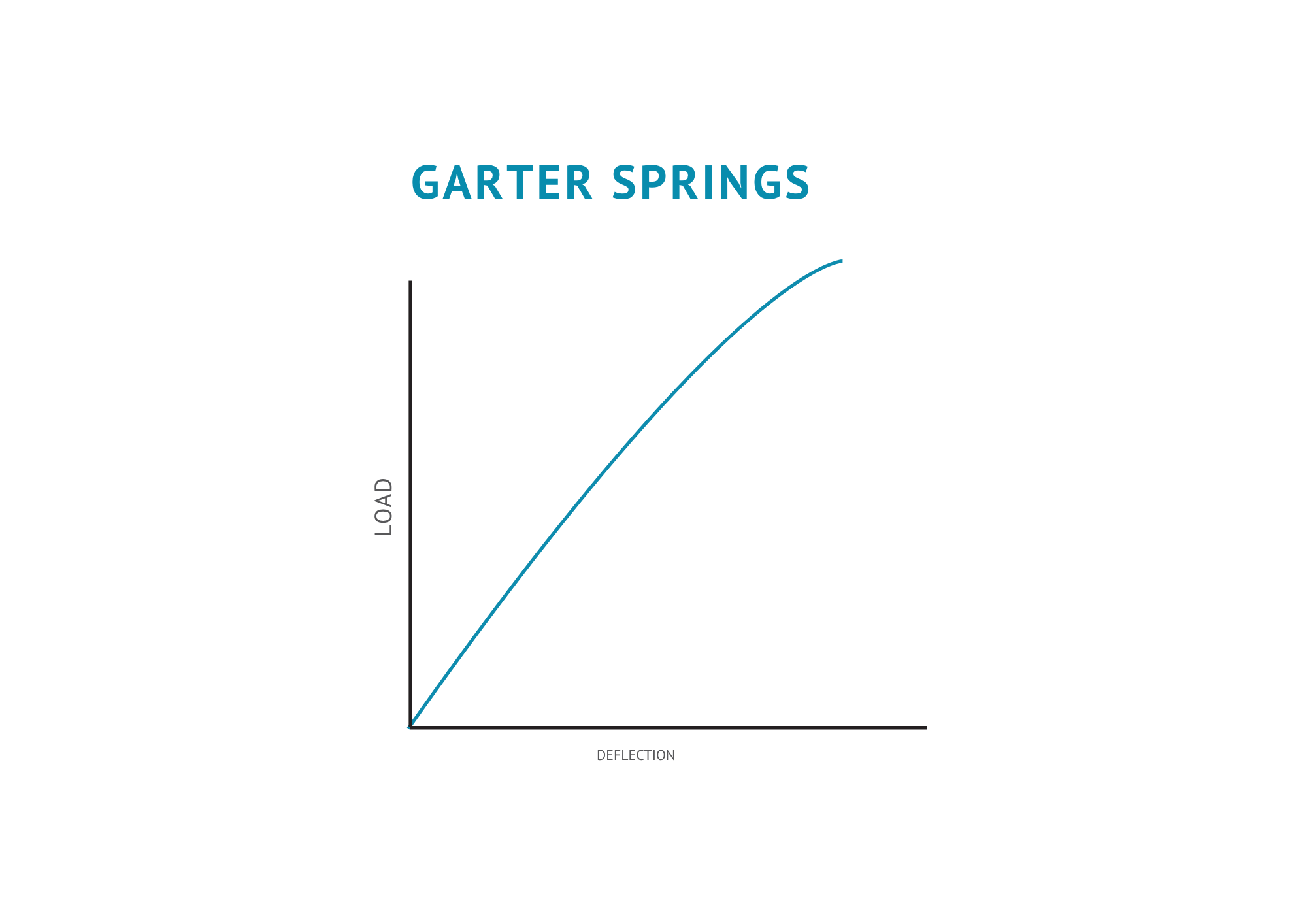
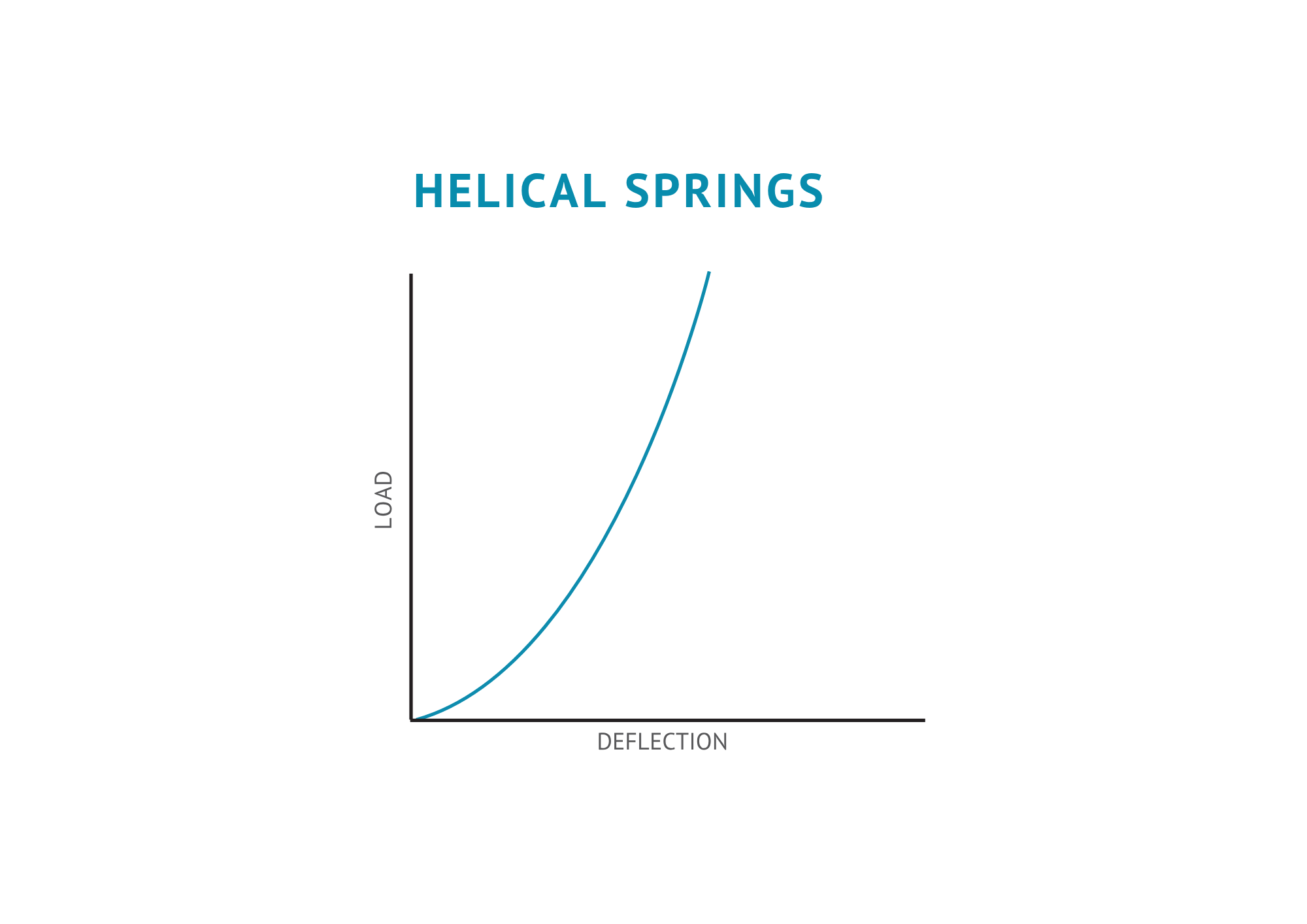
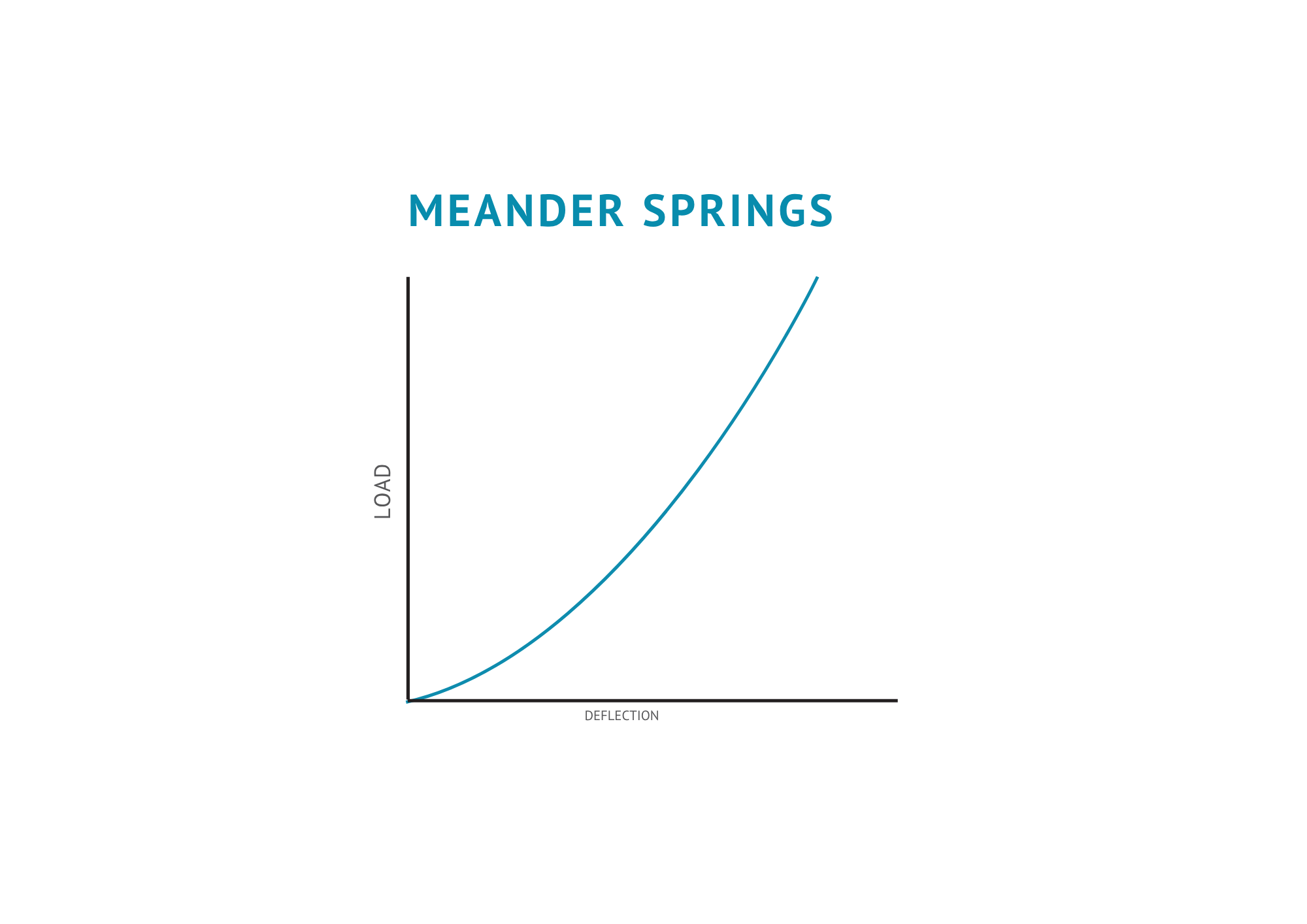
There is no such thing as a generic energising spring. The geometry of a spring determines its load curve — how much force it delivers, across what range of compression, and how that force changes as the seal wears over time.
Four of the spring types we manufacture cover the majority of seal energising applications, and each one has very specific characteristics.
The Garter Spring
Familiar, and proven over decades of use, the garter spring is the most commonly specified. It is an extension spring with its ends joined to form a loop, wrapping around a rod to apply radial force. From a design and manufacture perspective, it is straightforward to vary in size and design. Because it applies radial force around the rod, the load it delivers will gradually reduce as wear occurs within the sealing system.
The Helical Spring
Helical springs are produced from flat tape wound to a working diameter. Helical springs are particularly versatile and can be configured within seal assemblies for both radial and axial sealing applications depending on the seal assembly design. They offer high load in a compact space, which makes them useful where sealing forces are high and deflection range is limited. That limited deflection can make them unsuitable for high-wear applications, however, because once the available deflection is consumed, there is nothing left in reserve.
The Meander / Cantilever Spring
The completely different geometry of meander, or cantilever, springs (V and U profile) provides alternative strengths. Because the point of force application can be positioned very close to the actual seal lips, the deflection range is greater, allowing longer seal life as wear progresses. These springs are well suited to dynamic seals operating at elevated temperatures and are supplied in standard industry sizes.
Canted Coil
And then there is canted coil. The slanted coil geometry creates a force profile that is fundamentally different from every other spring type. Its key strength arises from the fact that the load at maximum compression is very close to the load at initial compression. As the seal wears, the load will remain relatively constant. The seal lips are never overloaded when new, and continue to receive consistent force as the seal ages.
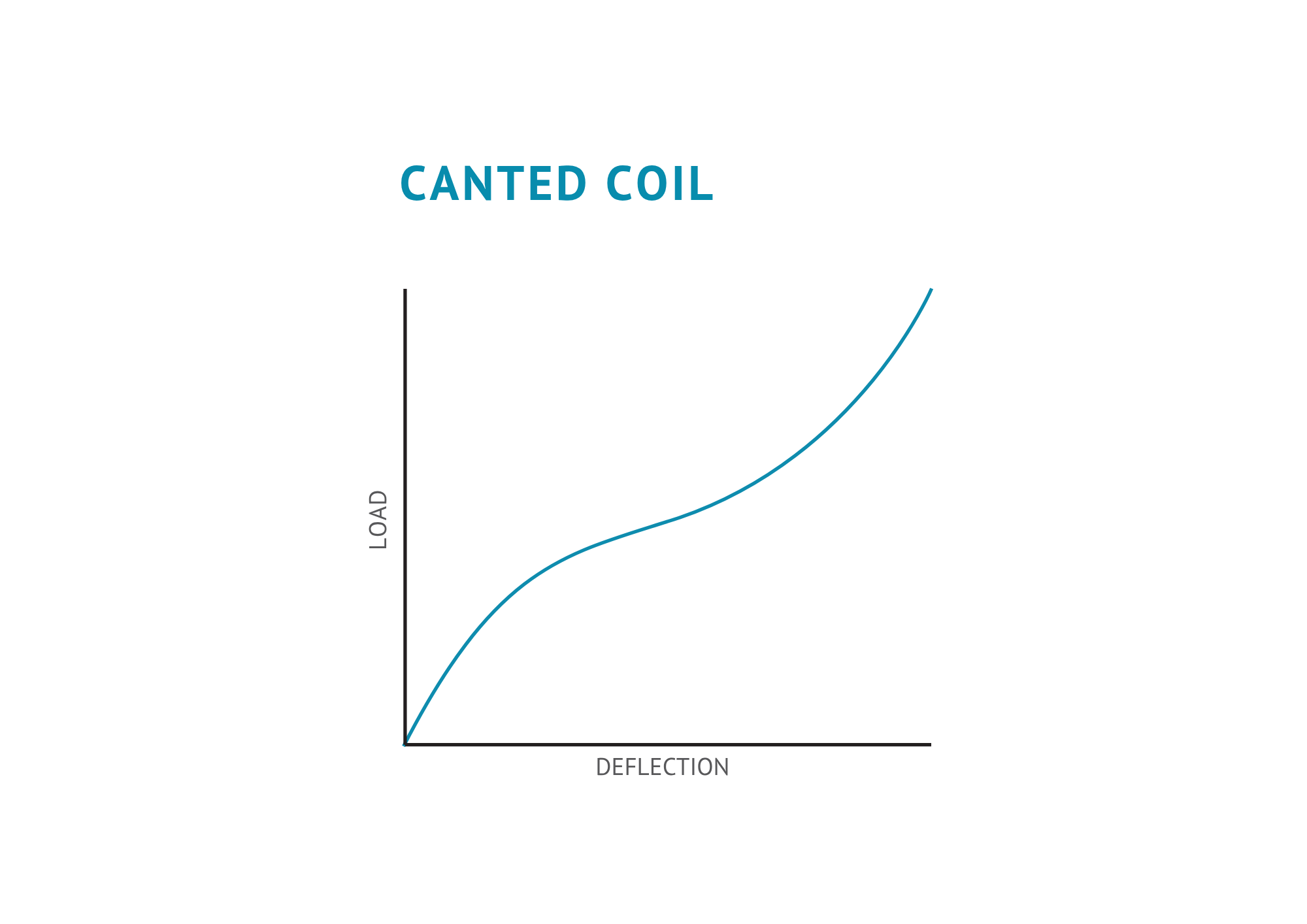
From an engineering perspective, the near-constant load characteristic of canted coil is a significant advantage. This allows both the seal and the spring to be specified based on long-term operating performance, not simply on their installation condition. In addition, in many valve seal applications one single canted coil can replace multiple compression springs. Its unique geometry makes it one of the most complex spring types to manufacture, and Clifford Springs is one of only a handful of companies globally who can manufacture it to the tolerances required for precision seal applications.
Variables That Influence Spring Performance
Even when the right spring type is selected, there are two particular variables which need to be taken into account to ensure the correct specification.
Deflection range and installed height
The spring rate is the force per unit of deflection. It is not always a linear profile giving a uniform increase in force for each deflection unit.
Traditional compression and extension springs usually have a linear rate where the load increase per unit of deflection remains constant (and this is why the spring rate is also referred to as the “spring constant” in some publications).
Clifford Springs can produce springs with variable spring rates, ranging from extreme low rates, where the load change through the deflection barely changes, through to springs where the load increases rapidly during the reflection.
Installing a spring with the wrong rating will lead to over or under-loading. Whilst this might not cause immediate failure, it will prevent optimum operation, shortening the seal life.
Ensuring the correct working spring specification will therefore extend seal life and improve long-term sealing performance.
Force distribution at the seal interface
Knowing that different springs apply force at different points within the seal assembly, and what impact this has on sealing performance, is also helpful when it comes to choosing the best spring for the job.
For example, Meander springs can place the load very close to the seal lips. This is a particular advantage in applications where the sealing surface is specific and the seal material benefits from localised pressure. In turn, helical springs apply force across both seal lips simultaneously. Whilst less controllable, it can be particularly useful in rod/bore seals.
Material Selection: A Multi-Variable Engineering Problem
When it comes to deciding upon different materials for energising springs, the most common reason for choosing an alternative to stainless steel tends to be based around corrosion resistance. The reality, however, is more complex.
Stainless steel does cover the majority of applications and is appropriate where conditions are not extreme.
302 offers strength and corrosion resistance for a wide range of environments.
316, with its molybdenum addition, provides superior resistance to chlorides and acids, making it the standard choice for chemical processing and marine environments.
17/7PH is heat-treated for higher strength and better fatigue properties, and is useful where the spring geometry demands formability as well as performance.
Exotic, or super, alloys have been developed specifically for performance in demanding environments, where requirements exceed what stainless steel can reliably cope with.
- Inconel offers high-temperature strength and resistance to oxidation and chloride-ion stress corrosion.
- Monel maintains excellent mechanical properties at sub-zero temperatures and performs well in seawater and both acidic and alkaline environments.
- Hastelloy offers superior resistance to pitting and crevice corrosion, with specific grades suited to sulphuric acid and sour gas environments.
- Elgiloy / Phynox, is a cobalt-chromium-nickel alloy combining high strength and excellent fatigue life with broad corrosion resistance. It is compliant with NACE ISO 15156-3, making it a valid choice for sour service applications in oil and gas.
- PEEK (polyetheretherketone) challenges the assumption that energising springs must be metallic. As a high-performance thermoplastic, PEEK offers exceptional chemical resistance, maintains its mechanical properties up to 170°C, and has a low friction coefficient that eliminates the surface wear associated with metal springs in certain applications. Non-metallic, non-magnetic and non-conductive, it is ideal for environments where a metal spring would create problems. Clifford Springs developed the first PEEK energising spring over twenty years ago, in response to a customer problem where a metal anti-extrusion spring was damaging the mating hardware. After twelve months of development, the PEEK spring extended the product’s service life significantly. Others have since followed, but scepticism toward a ‘plastic spring’ can be a barrier to its adoption in applications where it would genuinely outperform metal alternatives.
Again, material selection shouldn’t be a catalogue exercise. Temperature range, chemical compatibility, fatigue requirements, magnetic properties, electrical conductivity, regulatory compliance and cost all interact.
In some circumstances, conditions may even change over time, and the specification needs to take this into a account.
For the best specification, it’s vital to consider the operating environment, end to end, including its extremes.
At Clifford Springs we would always recommend choosing a material specifically suited to a corrosive environment than to apply a protective surface to one that is not. Once a coating is breached through wear, impact or service damage, the underlying steel will corrode, and the spring will eventually fail.
Why Springs Fail
Springs are the most highly stressed component in any assembly. That stress, combined with the environment it operates in, continually impacts on the spring throughout its service life.
There are four key reasons that contribute to the degradation of springs during their life.
High temperatures
High temperatures accelerate relaxation (the gradual loss of load that occurs in any spring held under sustained stress). And if stress levels are high, this will increase the rate of relaxation further. Specifying scragging or closing (hot setting or prestressing) will reduce relaxation rates and is particularly sensible when long-term load retention is required.
Low temperatures
Low temperatures can cause brittleness and increase the risk of failure under shock or impact loading. Choosing a material that delivers predictable, stable performance across the full range of temperatures the application will encounter, including the extremes, is a solution to this problem.
Corrosion
Corrosion reduces the load-bearing cross-section of the spring wire and changes its stress distribution. This leads to failure at loads well below the original design limit.
Fatigue
This is caused by repeated cycling. Fatigue life can often be improved through careful spring design, particularly by reducing the stress variation during operation as a percentage of the maximum theoretical stress limit. Specifying surface treatments, such as shot peening, can also help by reducing stress concentrations at the wire surface.
Manufacturing the best springs for the job
When you work with an experienced spring manufacturer, such as Clifford Springs, you get the benefit of experts who understand operating environments, their impacts on energising spring life, and the solutions that will mitigate against various issues.
The more we know about where, and how, the springs will be operating, the more we can help. Key information to share includes:
- Operating temperature range, including extremes
- Chemical environment – including potential contaminants or process impurities
- Dynamic or static application
- Consequences of failure
Taking these into account, in addition to spring rate, housing diameter, expected wear etc will help to determine everything that will ensure we can manufacture the best possible spring for your requirements
A spring is not just a spring. The more knowledge and expertise that goes into the design process, the better the final outcome tends to be.
If you are specifying energising springs for a demanding application and want to discuss the options, get in touch with our Technical Sales Manager, Graham Fowler.
graham.fowler@cliffordsprings.co.uk | +44 (0)1527 62876 | cliffordsprings.com